Our approach
Education for
what comes next.
The thinking behind everything Washington Consortium builds — why we teach the way we teach, and what we're actually trying to change.
The gap
Traditional education
matters. It just can't
teach everything.
How do you make a decision with incomplete information?
How do you persuade a room of something you believe in?
How do you recover when a plan falls apart in public?
How do you start something when no one tells you how?
Life asks these questions anyway. We think education should answer them.
The goal
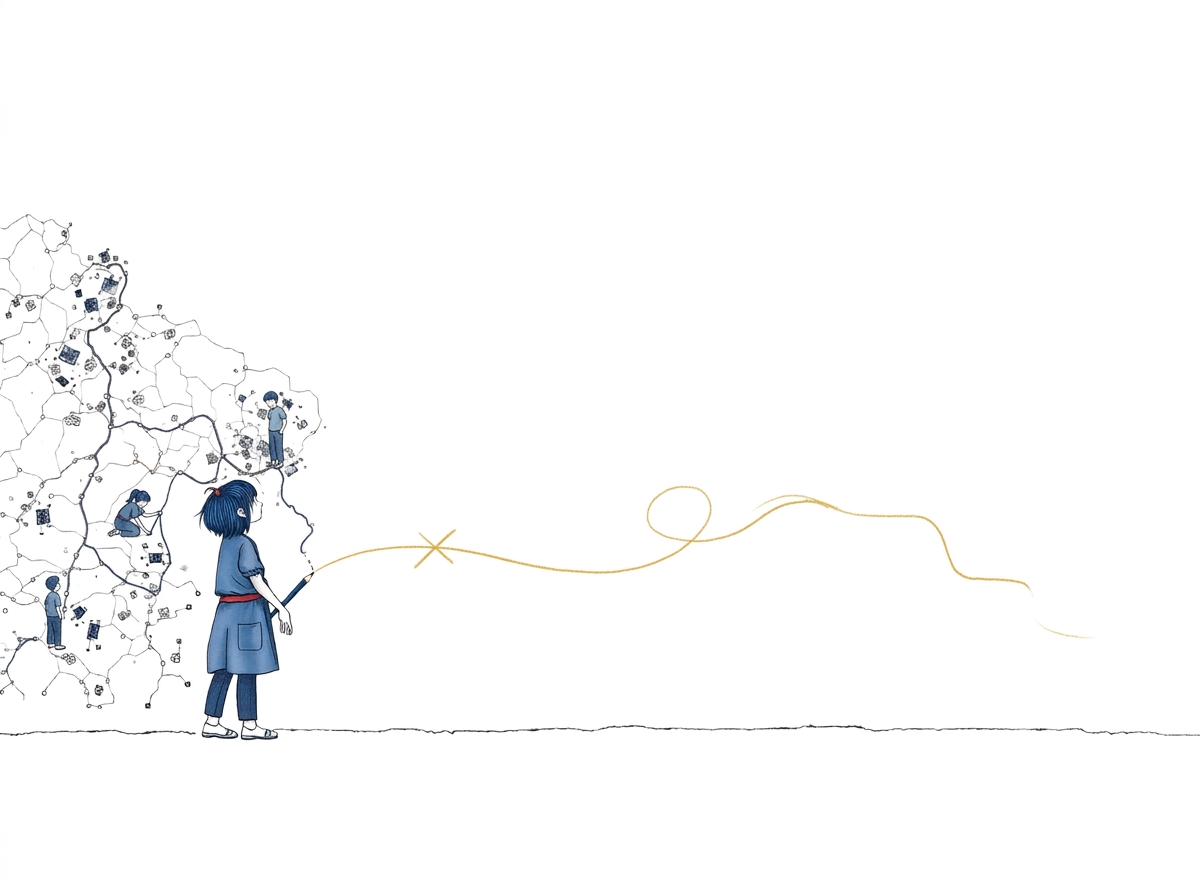
The word for it is agency.
Agency is the belief — backed by real experience — that you can shape what happens next.
It's not a personality trait, and it isn't confidence theater. It's what grows when someone has actually attempted things: made a plan, watched it break, fixed it, and finished anyway.
Agency is the difference between waiting for permission and making a plan. Between "someone should do something" and maybe I can.
The framework
Four capabilities.
Practiced, not preached.
BUILD
Turn ideas into action.
- Entrepreneurship
- Problem-solving
- Creativity
- Execution
LEAD
Bring people with you.
- Communication
- Collaboration
- Leadership
- Confidence
NAVIGATE
Understand the world you're operating in.
- Financial literacy
- Decision-making
- Planning
- Resourcefulness
RISE
Keep moving when things don't go as planned.
- Resilience
- Self-awareness
- Well-being
- Learning through failure
The methodology
A loop, not a lecture.
Every WC experience — for students and educators alike — runs on the same experiential cycle. Understanding arrives through contact with reality, not at the end of a slideshow.
Start with real frameworks — how ventures work, how money moves, how people are persuaded.
- 01
Learn
Start with real frameworks — how ventures work, how money moves, how people are persuaded.
- 02
Try
Put the idea in front of the world early, while it's still rough and still cheap to change.
- 03
Fail
Discover exactly where the thinking breaks. This is the part most classrooms skip.
- 04
Adapt
Rework the plan with evidence instead of assumption. Decide what to keep and what to cut.
- 05
Build
Make the thing: a project, a venture, a solution a community can actually use.
- 06
Lead
Bring other people with you — and help the next person do the same.
Failure
Failure isn't the
opposite of learning.
It's the method.
Most education treats failure as an accident to be avoided. We treat it as curriculum: the attempt, the miss, the adjustment, and the retry are where the actual learning lives.
That's why WC builds structured attempts into every program — so failure happens early, safely, and in the open, where it can be examined instead of hidden.
Not failure for its own sake. Failure in service of the next attempt.
Student as hero
Capability before
circumstance.
We don't define young people by where they start. A student's circumstances are context — never a ceiling. What matters is what they can practice, build, and become.
In WC's story, the student is never the beneficiary waiting to be helped. They are the hero doing the building. Our role is to hand them better tools and get out of the way at the right moments.
Where you're born is the opening line — not the ending.
The educator multiplier
One educator.
Hundreds of builders.
We could teach students one cohort at a time. Or we could equip the people who already stand in front of them — every week, every year.
Every educator we train carries the framework into classroom after classroom, cohort after cohort. That's how a small organization's impact compounds across schools, communities, and countries.
Educators aren't the audience. They're the engine.

Impact philosophy
We measure what changed —
not only who showed up.
Attendance is activity. What matters is outcome: ventures attempted, ideas rebuilt after failure, capabilities a young person can name and use. If nothing changed, the number in the room doesn't impress us.
Outcome figures are published as cohorts complete and results are verified.